
2026-05-20: AI Daily Briefing: Gemini 3.5, Karpathy at Anthropic, and the AI Infrastructure Race
Today's AI cycle is being shaped by three forces at once: frontier models are becoming more agentic, elite research talent is moving toward labs with strong safety and pre-training agendas, and the cost of AI infrastructure is starting to reshape corporate strategy.
Executive Summary
Google used I/O season to push Gemini further toward agent-style workflows, not just chat. Anthropic gained one of the most visible AI researchers in Andrej Karpathy. Meanwhile, OpenAI cleared a major legal risk after Elon Musk's lawsuit failed, and large-scale infrastructure spending remains the central pressure point for Google, Blackstone, Meta, and the wider AI economy.
1. Google Introduces Gemini 3.5 as an Agentic AI Platform
Google announced Gemini 3.5, positioning it as a model family built for stronger reasoning, coding, multimodal work, and tool use. The important signal is not only model quality, but direction: Google is framing the next phase of consumer and developer AI around systems that can take action across apps and workflows.
For developers, this points to more pressure to design products around agents, permissions, memory, and human review. For users, the shift means AI assistants may move from answering questions to coordinating tasks, searching, summarizing, coding, and acting with increasingly persistent context.
Original source: Google Blog - Gemini 3.5: frontier intelligence with action
2. Andrej Karpathy Joins Anthropic
Andrej Karpathy, a founding member of OpenAI and former Tesla AI leader, has joined Anthropic. This is more than a hiring headline: it reinforces Anthropic's role as one of the core frontier AI labs competing for world-class pre-training, safety, and product research talent.
The move is also symbolic. Karpathy has spent years explaining deep learning, AI education, autonomous systems, and model behavior to a broad technical audience. His presence at Anthropic may strengthen the lab's research depth and its public technical voice.
Original source: Axios - OpenAI co-founder Andrej Karpathy joins Anthropic
3. Google and Blackstone Plan a New AI Cloud Venture
Reuters reported, citing The Wall Street Journal, that Google and Blackstone are planning an AI cloud company using Google's specialized chips. The proposed structure would pair Google's AI hardware and cloud ambitions with Blackstone's capacity to finance data center buildout.
This is a major infrastructure story. Frontier models need chips, power, cooling, networking, and massive capital commitments. If AI demand keeps rising, cloud platforms may increasingly look like capital-heavy industrial systems rather than only software businesses.
Original source: Reuters via Investing.com - Google, Blackstone plan AI cloud venture with $5 billion backing
4. Elon Musk Loses Lawsuit Against OpenAI
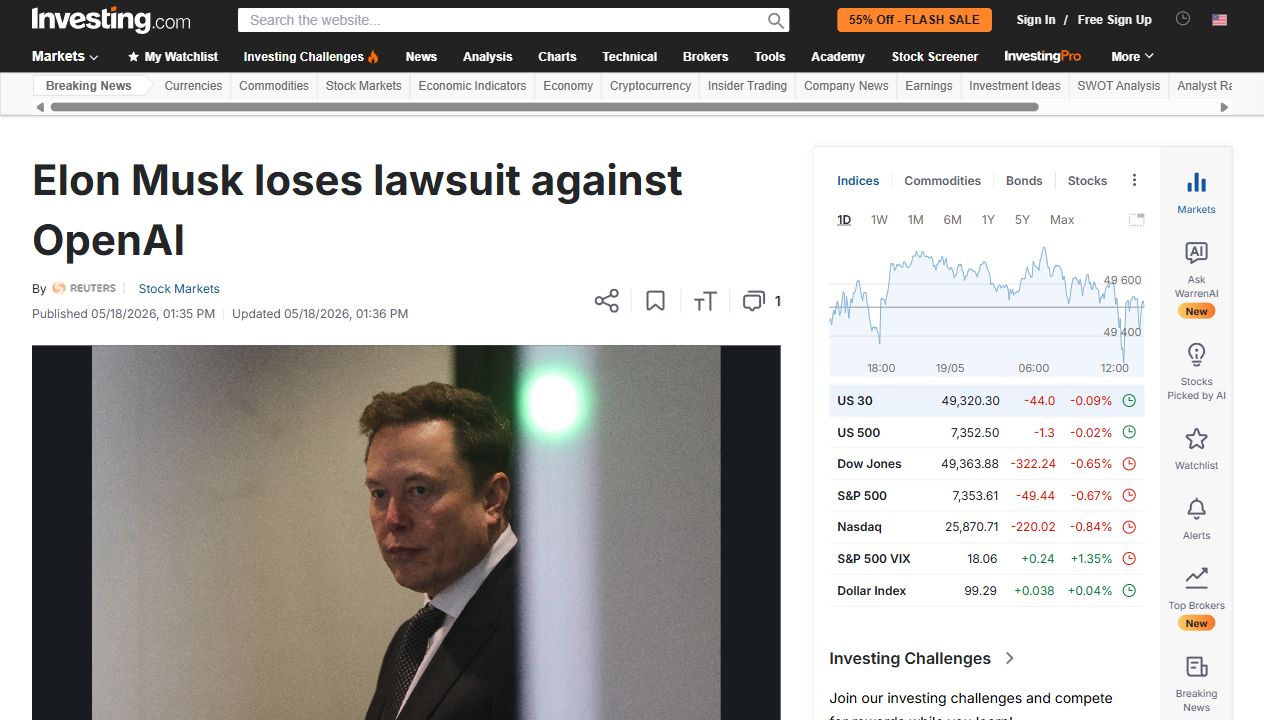
A U.S. jury ruled against Elon Musk in his lawsuit against OpenAI, finding that the claims were filed too late. The case had centered on Musk's argument that OpenAI had departed from its original nonprofit mission.
The practical impact is that OpenAI removes a significant legal overhang while it continues to raise capital, expand infrastructure, and develop commercial AI products. The broader debate, however, is not over: governance, nonprofit control, investor incentives, and public-interest obligations remain central questions for frontier AI companies.
Original source: Reuters via Investing.com - Elon Musk loses lawsuit against OpenAI
5. Meta's AI Infrastructure Spending Pressures Headcount
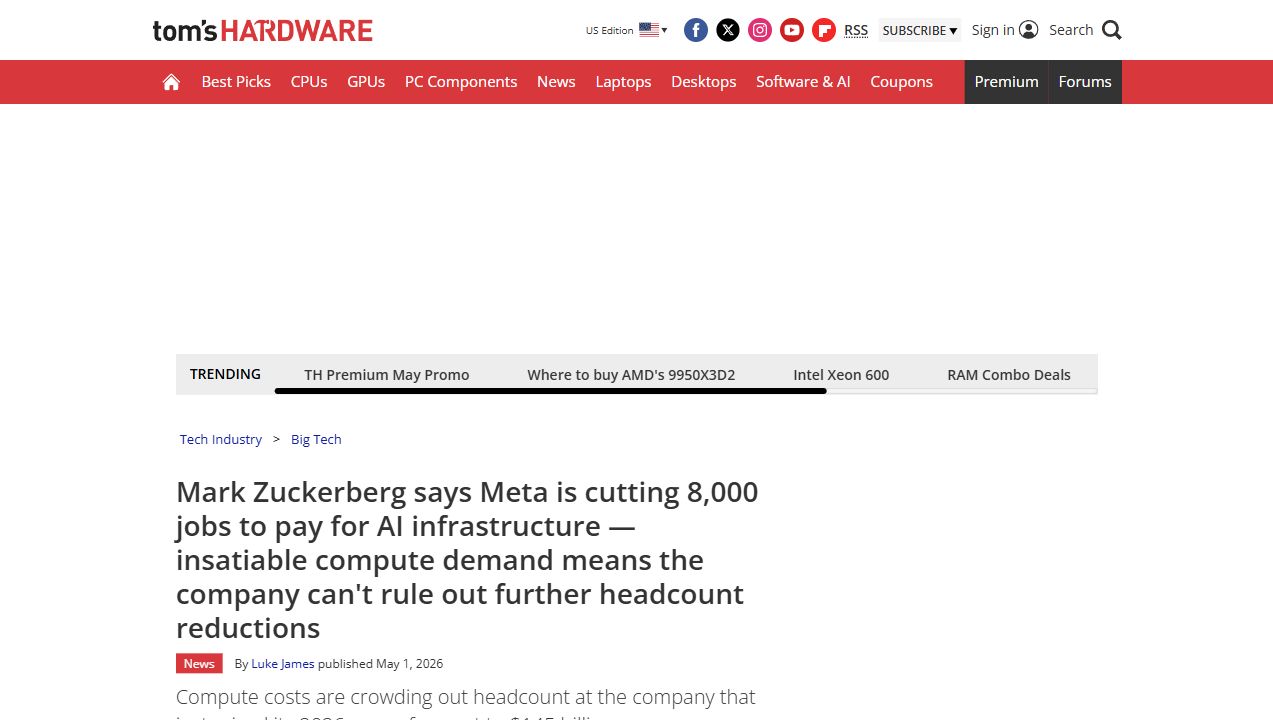
Reports around Meta's 2026 restructuring show how expensive AI infrastructure has become. The company is cutting thousands of roles while raising capital expenditure forecasts for compute and infrastructure. Even when AI is not the direct replacement for a specific job, AI spending can still reshape staffing priorities.
For analysts, this is an important pattern to watch. AI adoption is not only a product story; it is a capital allocation story. Companies are deciding how much of the budget should go to people, GPUs, data centers, internal automation, and new AI-native product teams.
Original source: Tom's Hardware - Mark Zuckerberg says Meta is cutting 8,000 jobs to pay for AI infrastructure
What This Means
The strongest theme today is that AI competition is no longer only about who has the best model benchmark. It is becoming a full-stack race across talent, chips, data centers, legal structures, product distribution, and capital markets.
For builders, the takeaway is to learn agent workflows, model evaluation, retrieval, permissions, and production monitoring. For data and business analysts, the useful lens is cost structure: AI strategy now shows up in capex, hiring plans, cloud partnerships, and risk disclosures.
Source List
- Google Blog - Gemini 3.5: frontier intelligence with action
- Axios - OpenAI co-founder Andrej Karpathy joins Anthropic
- Reuters via Investing.com - Google, Blackstone plan AI cloud venture with $5 billion backing
- Reuters via Investing.com - Elon Musk loses lawsuit against OpenAI
- Tom's Hardware - Meta AI infrastructure and job cuts